The Blind Spot in Healthcare Operations: Care Itself
Hospitals today have more data than ever. Patient flow, bed utilization, staffing levels, clinical outcomes, equipment utilization, and more — all tracked with increasing precision.
But one critical element of care is still difficult to capture: the interactions between staff and patients.
The moments when assessments happen, questions are answered, medications are administered, or monitored are the foundation of care delivery. But in most hospitals, they’re documented manually or reconstructed after the fact and are folded into workflows as an afterthought.
That creates an information gap. Not because processes are broken, but because the methods and tools for capturing these interactions are still largely manual. They haven’t kept pace with the rest of healthcare’s data infrastructure.
The Operational Gaps Created by Manual Documentation
Without a way to directly capture patient encounters, hospitals rely on protocols and manual reporting to understand what’s happening on the floor. That approach works — but it comes with challenges.
Compliance with rounding protocols—particularly intentional or purposeful rounding — requires audits and spot checks to be effective. Everything that gets documented manually adds workload to a clinical staff that’s already stretched thin. In fact, a 2022 U.S. Surgeon General advisory found that nurses spend up to 41% of their time on documentation and EHRs — time not spent with patients.
This is the core tension in healthcare operations: the need for accurate, complete records on one hand, and the need to make clinicians available for patient care on the other.
What Automated Interaction Capture Makes Possible
Automatically capturing staff-patient interactions in real time introduces a dramatically different kind of operational insight: objective, continuous, and data-driven based on what’s happening at the bedside.
Hospitals could move past the periodic, manual documentation to always-on understanding. The distinction between time spent at the bedside versus time spent at the nursing station becomes measurable. Patients who have not been visited within a set window are automatically flagged to decrease gaps in care.
Interaction frequency and time spent can be analyzed by unit or by shifts to inform staffing models, workflow, and patient care strategies.
Without the need for manual documentation, teams have more time for patients.
Capturing Staff-Patient Data at Scale Without Adding Work
Capturing this level of detail at scale has historically been hard. Most solutions require fixed infrastructure, workflow changes, or manual input — all barriers to adoption.
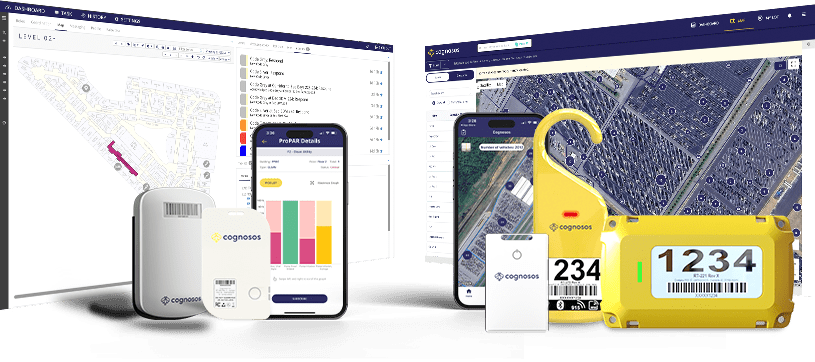
Cognosos’ AI-powered encounter-sensing technology is built to remove those barriers. A staff badge and a disposable patient wristband communicate directly with each other at short range. When they’re close to each other, the system automatically records that encounter. It’s timestamped, the duration is automatically logged, and it’s fed directly into the EHR for compliance. No input from staff is required.
The disposable wristband has been a goal of the industry for more than two decades. It eliminates the need for rechargeable or returned patient-worn hardware. That’s what makes true deployment at scale possible.
And because the system is built with beacon-less architecture without fixed infrastructure, wiring or cabling, it’s quick to implement and delivers insights at a fraction of the cost of traditional RTLS.
Beyond Staff-Patient Encounters: A Connected View of Care Activity
This technology captures more than just patient encounters. Patient engagement with beds and chairs, staff interaction with medication units and hygiene stations — it all becomes part of the same connected dataset.
That data also feeds downstream systems: smart rooms, digital whiteboards, and other hospital systems that can utilize interaction data to drive efficiency.
It can also power a real-time timeline of care — visible to patients and families via bedside tablets or apps — that shows exactly when and how often care has been delivered. That kind of transparency directly supports improved HCAHPS scores by giving patients and families confidence that their needs are being addressed.
The result isn’t a collection of isolated signals. It’s a continuous, AI-powered view of how people, patients, and equipment move through the care environment — across every unit and shift.
Closing the Last Gap in Healthcare Operational Visibility
Healthcare has made remarkable progress measuring operations, outcomes, and resources. What’s been missing is a scalable way to capture the interactions at the center of care itself.
Cognosos closes that gap — delivering the “last mile” of visibility, without adding infrastructure or burden to the people doing the work.
That last mile may turn out to be the most valuable one.
Learn more about staff-patient encounter monitoring from Cognosos.