
Hygiene
Automate Hand Hygiene Monitoring
Improve patient safety, outcomes, and compliance ratings, like the Leapfrog Group.
Healthcare systems spend billions every year on hospital-acquired infections, but manual observation only records less than 5% of hand hygiene incidents and inflates compliance rates because employees wash more when under observation. With AI-powered monitoring that deploys in a matter of days, requires significantly less infrastructure, and operates without the use of hospital WiFi, Cognosos Hygiene removes observer bias.
- Automatically track every hand hygiene event without manual observation
- Identify missed opportunities to improve compliance and reduce HAIs
- Deliver real-time unit-level performance insights
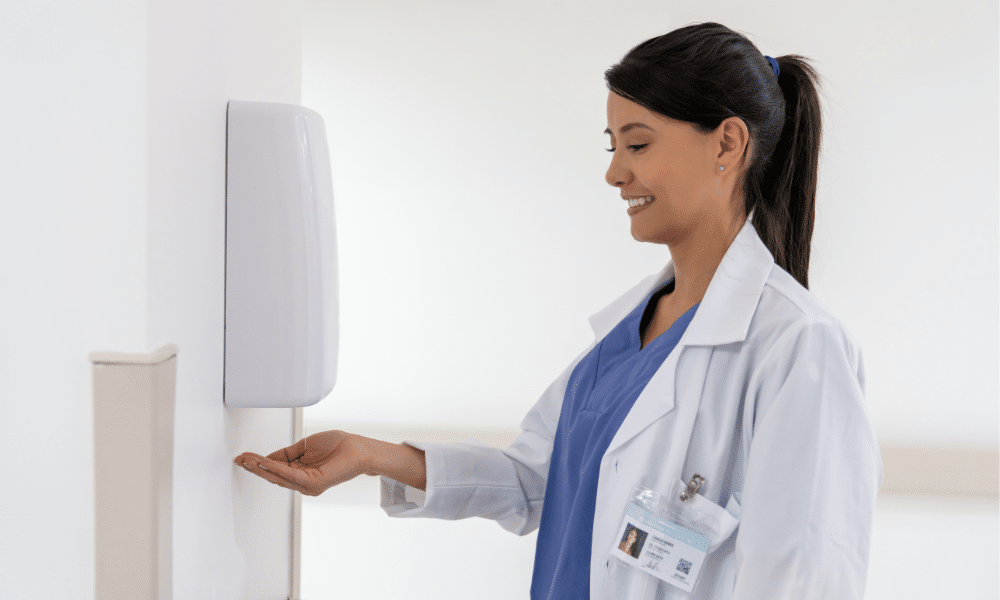
Partner with Cognosos to improve patient safety
Every year, 2 million patients contract healthcare-associated infections.
CDC
Up to 70% of HAIs are preventable with proper infection control
World Health Organization
Average hand hygiene compliance rates in hospitals range from, 30% to 50%
World Health Organization
HAIs cost hospitals $28 to $45 billion annually.
Leapfrog Group / AJIC
Direct observation overestimates compliance by 200% to 300%
AJIC
Why Direct Observation Falls Short
Direct observation has long been considered the gold standard for measuring hand hygiene compliance. In practice, it introduces more issues than it solves.
The Hawthorne Effect skews every audit
Research suggests that healthcare professionals carry out hand hygiene considerably more frequently in the presence of an auditor, versus the absence of an auditor. Your compliance data is indicative of employee behavior in the presence of an auditor, rather than employee behavior with patients.
Manual audits miss most of what happens
A few small percentage of actual hand hygiene events are observed in the majority of hospitals. The bulk of compliance behavior is therefore unobserved. Manually auditing to meet Leapfrog observation requirements is extremely time and labor intensive.
Self-reported data tells a different story
Research shows large gaps between self-reported and observed compliance rates. These gaps represent real infection risk hidden behind optimistic self evaluations.
Intelligent hand hygiene monitoring for a safer healthcare environment
70%
Of HAIs are preventable with proper infection control
WHO
Drive higher hand hygiene compliance with our advanced electronic monitoring systems. Gain a clear view of compliance data at the facility, department and individual levels to identify trends and areas of improvement. Create a safer work environment and lower the chances of HAIs.
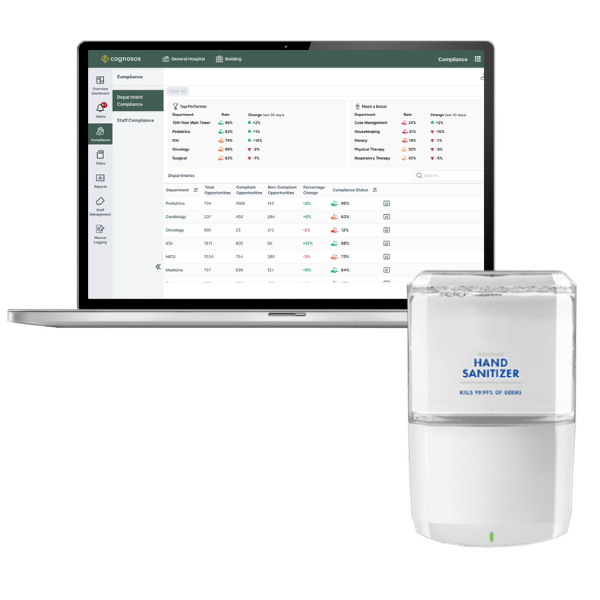
How Cognosos Hygiene Works
AI-Powered Room-Level Accuracy with Minimal Infrastructure
Cognosos Hygiene uses an entirely different approach than legacy real-time location systems. There’s no need for every patient room to contain sensors or for our system to be integrated with your hospital WiFi network. We function on a unique Bluetooth Low Energy network utilizing Al-powered location inference to solve the problem.
Lightweight Staff Badges
Healthcare workers wear small, unobtrusive tags that require no charging stations or daily maintenance. Long battery life and no line-of-sight requirements mean the system works reliably across all clinical environments without disrupting workflows.
Universal Dispenser Sensors
Our sensors retrofit to existing soap and sanitizer dispensers from any manufacturer. You keep your current dispenser infrastructure and preferred hygiene products. The sensors detect actual dispensing events, not just proximity, ensuring accurate compliance measurement.
Room-Level Location Sensors
Strategically placed sensors detect room entry and exit with precision. Unlike legacy systems that require wiring throughout patient rooms, Cognosos sensors operate on our dedicated BLE network. This eliminates IT integration complexity and prevents any interference with existing hospital WiFi infrastructure.
LocationAI Engine
Our patented LocationAI technology delivers room-level precision without requiring sensors in every location. The AI engine learns your facility’s unique characteristics and continuously improves accuracy over time. This approach dramatically reduces hardware requirements while maintaining clinical-grade location data.
Real-Time Cloud Dashboard
Access compliance data instantly from any device. The dashboard displays performance by individual, unit, shift, and role. Infection preventionists can identify patterns, target interventions, and document improvement for regulatory reporting. Automated alerts notify supervisors when compliance drops below thresholds.
Why Less Hardware?
Legacy RTLS systems require extensive wiring in every patient room and depend on hospital WiFi infrastructure for data transmission. This creates months-long installation timelines, room closures during construction, and ongoing IT support burden. Cognosos operates on its own BLE network with AI-powered location inference, eliminating IT integration headaches and reducing deployment from months to days.
Leapfrog, Joint Commission, and CMS Requirements
Regulatory pressure on hand hygiene compliance continues to intensify. The Joint Commission can cite hospitals for observed hand hygiene failures. Leapfrog requirements have driven widespread adoption of monitoring programs. Electronic monitoring provides the documentation and improvement data these standards demand.
| Regulatory Body | Requirement | How Cognosos Helps |
|---|---|---|
| Leapfrog Group | 200 observations per unit per month across five domains: Monitoring, Feedback, Training, Infrastructure, and Culture | Captures thousands of observations per unit monthly, far exceeding minimum requirements. Automated feedback and trend reporting address all five domains. |
| Joint Commission | Documented improvement program following CDC and WHO guidelines. | Continuous monitoring provides complete audit trail. Real-time data identifies intervention targets and documents sustained improvement over time. |
| CMS HAC Program | Hospitals with higher hospital-acquired condition rates face reduced reimbursement. | HAI reduction documented through compliance data directly impacts HAC metrics and protects reimbursement rates. |
Discover how Cognosos Hygiene can help your organization
Reduce healthcare associated infections (HAIs)

Enhance patient experience & staff productivity
Promote regulatory compliance through comprehensive & reliable data

Reduce risk and financial impact of HAIs
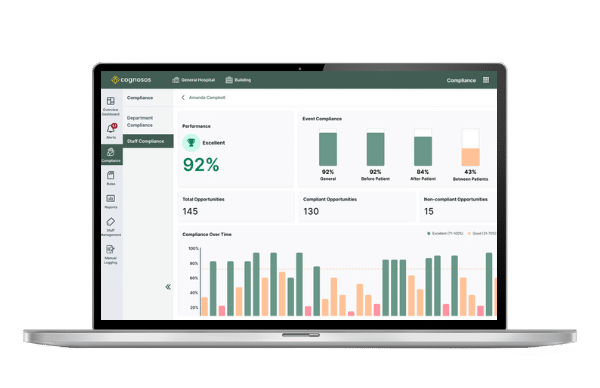
Intuitive. Customizable. Extensive.
Comprehensive compliance data
~40%
Average hand hygiene compliance rates in hospitals
WHO
Gain unrivaled insights into hand hygiene compliance. Cognosos delivers intuitive, customizable, and extensive tracking of healthcare worker hand sanitization. Capture precise data on every entry and exit of patient spaces and track overall, staff group, role-based, individual, departmental, and shift-based adherence.
Real-time visibility
Instantly monitor compliance via dynamic dashboards.
Tailored to your needs
Implement facility-specific activation alerts. individual room safety rules, and timeframe adherence based on room type.
Actionable analytics
Unlock operational insights with robust reporting.
Cognosos Hygiene
Hand Hygiene Compliance
Every day without comprehensive hand hygiene monitoring is another day of preventable infections, regulatory risk, and hidden liability. Cognosos Hygiene gives infection preventionists the data they need to drive real improvement while satisfying Leapfrog, Joint Commission, and CMS requirements.
Schedule a personalized demonstration to see how AI-powered electronic monitoring can work in your facility. Our team will show you actual compliance data, walk through the dashboard, and answer your questions about deployment timeline and integration with your existing infrastructure
Request a demo
Hand Hygiene Monitoring FAQs
How does electronic hand hygiene monitoring differ from direct observation?
Direct observation relies on trained auditors watching staff interactions with patients. This approach captures only a small percentage of hand hygiene events and inflates compliance rates because staff wash more when they know someone is watching. Electronic monitoring captures all events passively through sensors and badges, providing unbiased data that reflects actual clinical behavior.
What are the CDC guidelines for hand hygiene in healthcare?
The CDC recommends hand hygiene before touching patients, before performing aseptic tasks like placing IV lines, after touching patients or their immediate surroundings, and immediately after removing gloves. Alcohol-based hand sanitizer is the preferred method in most clinical situations because it is faster, more effective against most pathogens, and less irritating to skin than soap. Soap and water are required when hands are visibly soiled, after using the restroom, or when caring for patients with C. difficile or norovirus.
What does Leapfrog require for hand hygiene compliance?
Leapfrog requires hospitals to collect compliance data on at least 200 hand hygiene opportunities per unit per month. Hospitals must also meet standards across five domains: Monitoring, Feedback, Training and Education, Infrastructure, and Culture. Electronic monitoring systems like Cognosos capture thousands of opportunities per unit monthly, far exceeding the minimum requirements while providing automated feedback and comprehensive trend data.
How long does implementation take?
Whereas legacy RTLS systems take months of IT integration, construction within patient rooms, and extensive planning and coordination across departments, Cognosos deploys in days to weeks. Our dedicated BLE network obviates the need for hospital WiFi integration and our Al-powered location inference means much less hardware to install. Most facilities achieve full deployment without ever closing a patient room.
What are the OSHA requirements for hand hygiene?
Under the Bloodborne Pathogens Standard (29 CFR 1910.1030), OSHA requires employers to provide readily accessible handwashing facilities for employees. When facilities are not immediately available, employers must provide antiseptic hand cleanser with clean towels. Employees must wash hands immediately after removing gloves and after any contact with blood or potentially infectious materials. OSHA has confirmed that alcohol-based hand sanitizers are acceptable when there has been no occupational exposure to blood or body fluids.
How does the system handle multiple patients in the same room?
Cognosos tracks hand hygiene compliance based on room entry and exit events combined with dispenser activations. In multi-patient rooms, the system monitors whether hand hygiene occurs upon entry and after interactions. The dashboard provides unit-level and facility-level views that account for the specific room configurations in your facility.