Ask any hospital IT leader what they wish their EHR could do, and you’ll hear a familiar list: automated room turnover, real-time patient flow, billing that reconciles itself, compliance records that don’t rely on a nurse remembering to chart every bedside check. None of this is new. Hospitals have talked about the “smart room” for the better part of a decade, and every EHR and specialty workflow vendor has built modules to support it.
So why does so much of it still happen manually?
The Real Problem: Location Data Accuracy
Every one of these workflows depends on a single, deceptively hard input: knowing, with certainty, when a specific staff member was physically with a specific patient — not “somewhere on the unit,” but at the bedside, at a specific time, with no ambiguity.
That last requirement has been the sticking point. It’s the healthcare equivalent of what network engineers call the “last mile” problem — fiber may run right past the building, but if the final connection into the house is unreliable, none of the bandwidth upstream matters. Hospitals have the EHR infrastructure; what they’ve lacked is a location signal accurate enough to trust.
Traditional RTLS Isn’t Accurate Enough to Automate Workflows
It’s very typical to hear real-time location systems (RTLS) resolving equipment position to a radius of 15 feet with only 60% to 65% accuracy — enough for asset tracking, not enough to automate clinical or billing workflows. A margin that wide means a specialist walking down the hallway can register as being in a patient’s room, triggering a false positive. In healthcare, a billing mistake like that can cause serious compliance and fraud risk. That single fact has kept hospitals conservative about automating billing at all, because the cost of being wrong outweighs the value of being fast.
Why Wristbands Haven’t Been Cost-Effective at Scale
The other half of the problem has been economics. Reusable badges create operational drag and cost — someone has to attach, remove, and sanitize them. Hospitals that have tried it lose a large percentage to walk-offs every year. Disposable alternatives solve the handling problem but not the cost one: even at a modest $5 to $10 per-unit price, a hospital seeing several million patients a year can turn a “cheap” wristband into a multi-million-dollar annual line item.
Why Partial Coverage Can’t Support Automation
Accuracy and cost also aren’t problems hospitals can solve halfway. A workflow automation only works if it captures essentially every encounter — the scheduled surgical patient and the trauma case who arrived by helicopter with no check-in at all. Partial coverage still requires manual documentation of the gaps. If it isn’t 100%, it’s effectively 0%.
What Accurate Location Data Unlocks for Hospitals
Once hospitals can trust the data, stalled workflows finally become possible to automate. Areas that benefit include:
- Throughput. When a system can verify, without human input, that a patient has been moved, is in transit to imaging, or has been discharged, hospitals stop losing time to “where did they go” gaps in room turnover, bed management, and capacity planning.
- Compliance. Verifiable, timestamped records of staff-patient interactions give hospitals a defensible answer to questions that used to rely on memory — how often was a nurse at the bedside overnight? Was a rounding protocol followed?
- Billing integrity. Accurate interaction data means billable events can be captured automatically, instead of hospitals under-billing to stay safely on the right side of fraud risk.
The result is a smarter EHR created by feeding those systems a data point they can finally trust.
How Cognosos’ Disposable Wristband Closes the Last Mile
An ideal solution has to clear a high bar: confirm a staff-patient encounter with absolute certainty, do it at a cost that scales hospital-wide, and work with the EHR systems already in place.
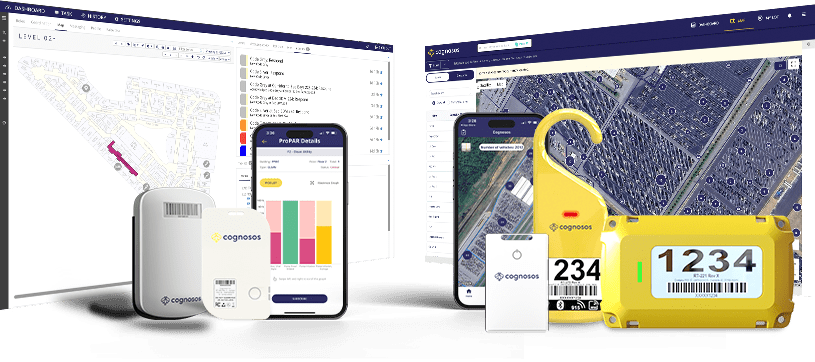
Cognosos built its disposable wristband architecture to clear that bar. Instead of relying on fixed sensors to estimate where a badge might be, the system uses near field peer-to-peer sensing: a Cognosos staff badge and bed tag engage directly with a disposable patient wristband, and only log a match when the two are within close bedside range — roughly arm’s length. The result is a timestamp that doesn’t approximate a staff-patient encounter, it confirms one and delivers:
- Bedside-level confirmation, not room-level estimation. A clinician in the hallway can’t generate a false encounter — the data reflects presence at the bedside, not proximity.
- Quick, low-infrastructure deployment. Because the system runs on peer-to-peer sensing rather than cabled RTLS hardware, there’s no months-long installation or wiring — hospitals can be live in a fraction of the time traditional tracking requires.
- Encounter-only reporting, built for privacy. Staff badges log a bedside encounter when it happens — they don’t continuously track staff location, so hospitals get the data they need without turning it into full-time surveillance.
- Disposable, low-cost deployment. The wristband is inexpensive enough to deploy hospital-wide and discard after use, with no washing, collection, or walk-off losses to manage — removing the cost barrier that has kept prior systems confined to a single unit like the OR.
- True hospital-wide coverage. Because cost and handling aren’t limiting factors, the wristband can go on every patient — scheduled admissions and unplanned trauma cases alike — supporting full automation, not a partial pilot.
- Works with the EHR already in place. The system feeds a confirmed encounter directly to any EHR a hospital runs, with zero manual data entry.
With the ability to deliver trustworthy data, the automation hospitals have wanted for a decade — faster throughput, defensible compliance, accurate billing — is no longer aspirational. It’s operational. Ready to learn more? Get in touch.